Get more leads with evidence-based UX
Evidence-based UX isn’t about letting data design the website for you; it’s about using data to validate your creative instincts.

Olly Clapp brings creativity and expertise to his role as a Senior Designer at Itineris, a dynamic digital marketing agency renowned for its innovative strategy, branding, and web development solutions. With expertise in conversion optimisation, accessibility, and brand performance, Olly consistently delivers impactful projects that drive client success.
The Intuition Upgrade
Decision-making in website design and strategy has been an eternal tug-of-war between creative, experiential approaches and the target-driven, functional approaches. Each approach has its champions throughout the design and build process, and the discussion is often made more complex by additional stakeholders arguing their KPIs are the ones we should be catering for over any others.
We believe effective user experience (UX) sits at the intersection of three key pillars:
Psychology: reinforced by best practice principles
Predictive modelling: using powerful tools which lean on AI learning to predict large sample user behaviour and cognition
Behavioural patterns: unpacking real analytics data and discovering how your users are using the website
Usability and foundational principles
Usability is a well-researched area of website design, and the core tenets stem from accumulated data across the history display design.
Usability is at the core of UX, so we set the foundations of web design by asking key strategy questions:
- Who are we designing for?
- What do the users expect to be able to do?
- What do we want users to do?
- What value will it provide?
- What does success look like, and how do we measure it?
Reducing the learning curve is critical. Users will come to any new website with particular learned behaviour formed from years of internet browsing. Familiar layouts or interaction patterns reduce friction, allowing users to understand the website and navigate it clearly. Smaller elements, such as iconography choice or button placement, can inform a user of a clear target, or inadvertently bring them to a dead-end. This UX principle is known as Jakob’s Law.
A large element of applying Jakob’s Law involves establishing a sensible information architecture that allows users to scan an interface without reading every word. Understanding users scanning patterns and their attention span helps inform content and hierarchy, and balance visual weight on a screen. Call-to-action placement and the users take to reach it is documented as Fitts’s Law.
Pre-Launch Validation
Before a design is shown to a client, we analyse it with a series of tools to determine whether it’s well suited to the strategy and easy to understand.
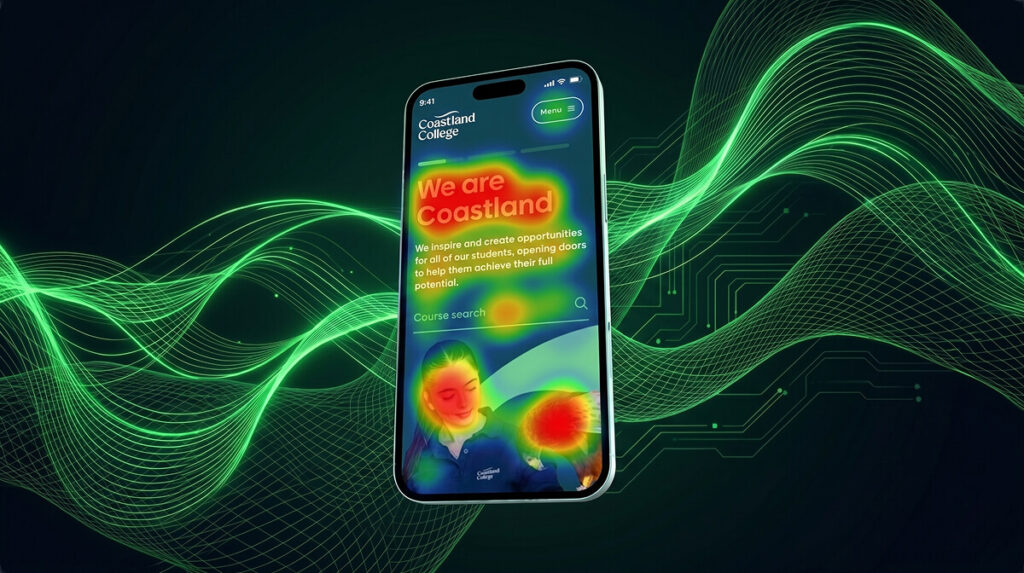
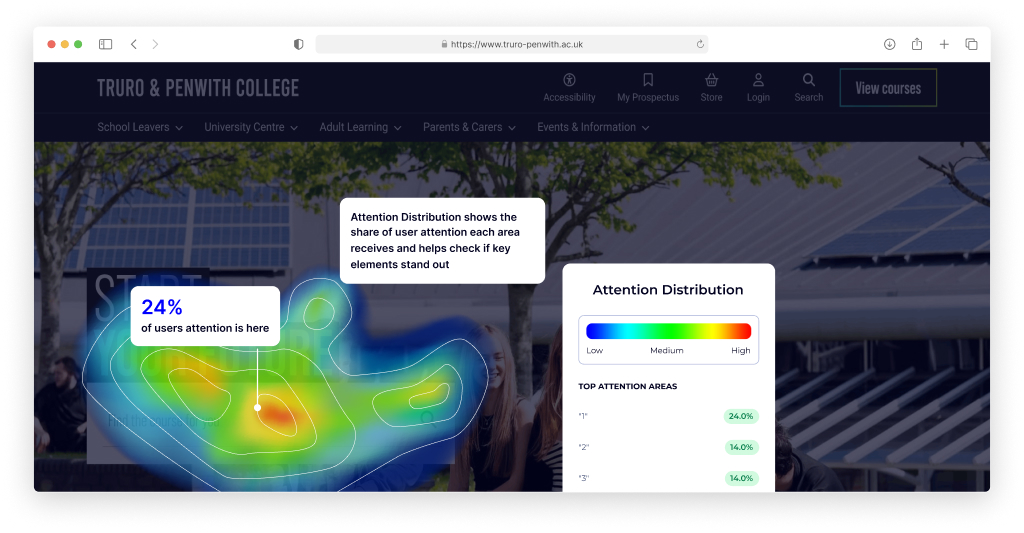
By using tools trained on tens of thousands of real eye-tracking studies, we can simulate human visual attention within a 90%+ accuracy rate. We can use this with AI to generate attention heatmaps, areas of interest, focus maps and cognition measurement.
The outcomes from these tools can help establish if information is organised in a way that is busy and hard to comprehend, and lead designers to solutions that balance brand, messaging and purpose.
We can now determine if a CTA is overpowered by an image, or whether headers or mega menus are overwhelming. We’re able to see whether the UI creates distractions from the main route into the website, or whether elements below the fold ever get seen.
Post-Launch Reality
Once live, we track real user interactions to see exactly how people navigate your site. This data allows us to constantly fine-tune the experience – optimizing layouts based on actual user behaviour and scaling the specific methods that are proven to work.
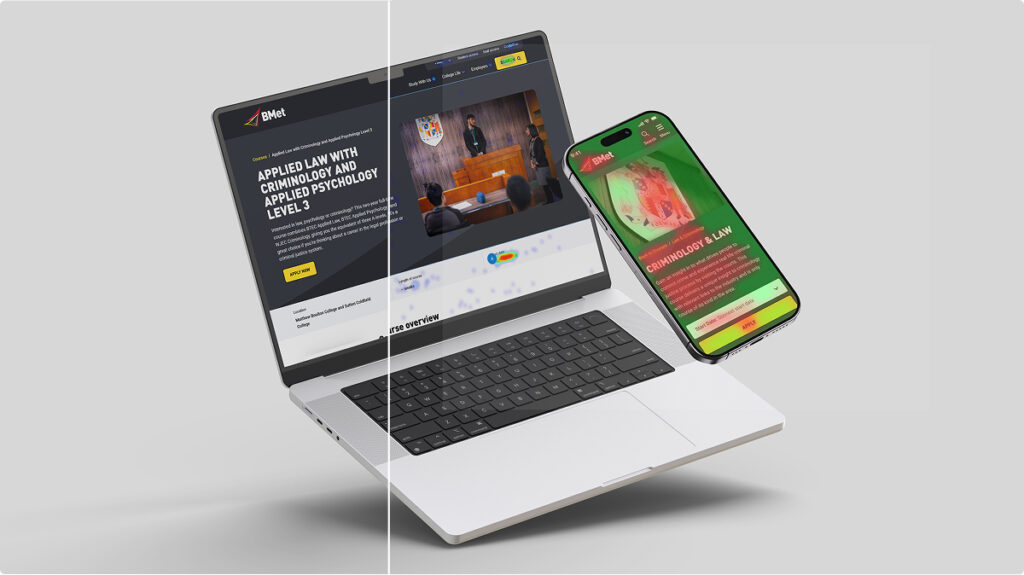
There are tools providing high-value qualitative data. By watching recorded sessions, compiled heatmaps and detected behaviours such as rage-clicking, dead clicks or quick-backs, we can see how individual users navigate the website. We can layer this information to understand patterns. This helps us see where users expect certain elements to be, what they expect buttons to do, and where the failure points are.
We combine these learnings with quantitative data. Analytics tools such as GA4 allow us to see traffic origination, engagement and how traffic funnels through the website. We can learn about users, build profiles and ensure the website meets the expectation of every target audience. We set key events and track specific properties to either validate design decisions or leverage the insights to inform enhancements.
Data ultimately helps inform good design decisions
Evidence-based UX isn’t about letting data design the website for you. We are using data to validate our creative instincts, which when applied to brands and moulded with strategy, means we launch with a platform that is grounded with well-informed decision-making, and a framework that supports all areas of the experience.
A positive experience on the website is critically important and goes beyond the aesthetic. With these methods, we understand what users want from a website and marry that with what success looks like for you, the client.