Why UX is Critical to Website Performance and ROI
Generating awareness and traffic may be key to a successful enterprise website, but converting that attention into meaningful commercial impact is what really matters. This is where strategic UX is so crucial.
Beneath the surface of traffic, campaigns, and content performance, there’s an invisible layer that shapes outcomes. It either accelerates growth or limits it. The difference between a website that performs and one that underdelivers often comes down to how effectively your digital investment is translated into action. For organisations operating at scale, this gap is where significant value is either captured or lost, often without clear visibility into why.
In this guide, we break down some of the core considerations around UX and why it’s one of the most critical drivers of ROI for any commercial website.


Luke is the Lead Designer at Itineris, specialising in creating compelling digital experiences that blend creativity with strategy. With a strong focus on lead conversions, he crafts user-centric designs that not only captivate but also drive results. His keen eye for detail and passion for innovation ensure brands stand out through engaging visuals and seamless interactions.
Table of Contents
- Rethink UX Beyond a Design Layer
- Moving From ‘Good’ Design to Measurable Results
- How UX and ROI are Connected
- Consider UX in Journeys Beyond Pages
- Understanding Enterprise UX Limitations
- UX Strategy Should Be Data-Driven
- Optimising UX is a Continuous Exercise
- Taking a Structured Approach to Enterprise UX
- UX and Enterprise WordPress
- Treat UX as a Strategic Investment
Rethink UX Beyond a Design Layer
Too often, user experience is treated as a purely visual exercise. Many brands refine elements like colours, layouts, and interactions as an isolated UX practice, while their commercial performance is left to marketing channels or sales teams.
However, the reality is that UX plays a major role in whether your digital investment delivers a return. Forrester research shows that every $1 invested in UX design yields $100 in return, an ROI of 9,900%.
You can invest heavily in SEO, paid media, and content, but your digital experience could still fail to convert intent into action. This doesn’t mean that your marketing investments are not wisely placed, but it may mean that these investments are diluted. Quite simply, traffic without progression is a waste. Improvements in UX design directly fix this, driving 20-200% conversion rate growth.
This challenge becomes even more pronounced for enterprise organisations. With complex user journeys, multiple stakeholders, and high value conversions, even small inefficiencies in UX can have a significant financial impact.
Ultimately, UX is a key mechanism that turns attention into revenue. It’s not a finishing touch or just an aesthetic consideration. It’s a crucial part of how your digital presence attracts, engages, and converts.
Moving From ‘Good’ Design to Measurable Results
Conversations around UX often default to subjective judgement, instead of being rooted in measurable data.
Teams might debate whether something looks good or feels modern. While this framing may have its reasoning, it is also unhelpful in terms of digital performance. Rather than looks or gut feel, UX should be evaluated and implemented based on effectiveness.
An effective experience helps users achieve their goals with clarity and confidence. It removes friction at critical decision points. It aligns user intent with business outcomes.
Every interaction on your website either supports user progression or introduces resistance. Getting UX right is the most important step to achieving the latter, which directly translates to measurable outcomes. Clearly, this is something that can be measured and monitored, not just something that looks or feels ‘good’.
In enterprise environments, ineffective UX is not always obvious, appearing in subtle ways. However, it;s impact is clear. This could involve navigation that slows users down, content that answers the wrong questions, or journeys that break between channels.
Individually these issues might seem small, but collectively they erode conversion rates and reduce the return on every marketing activity. By shifting from subjective design to measurable effectiveness, UX begins to unlock real, tangible value.
How UX and ROI are Connected
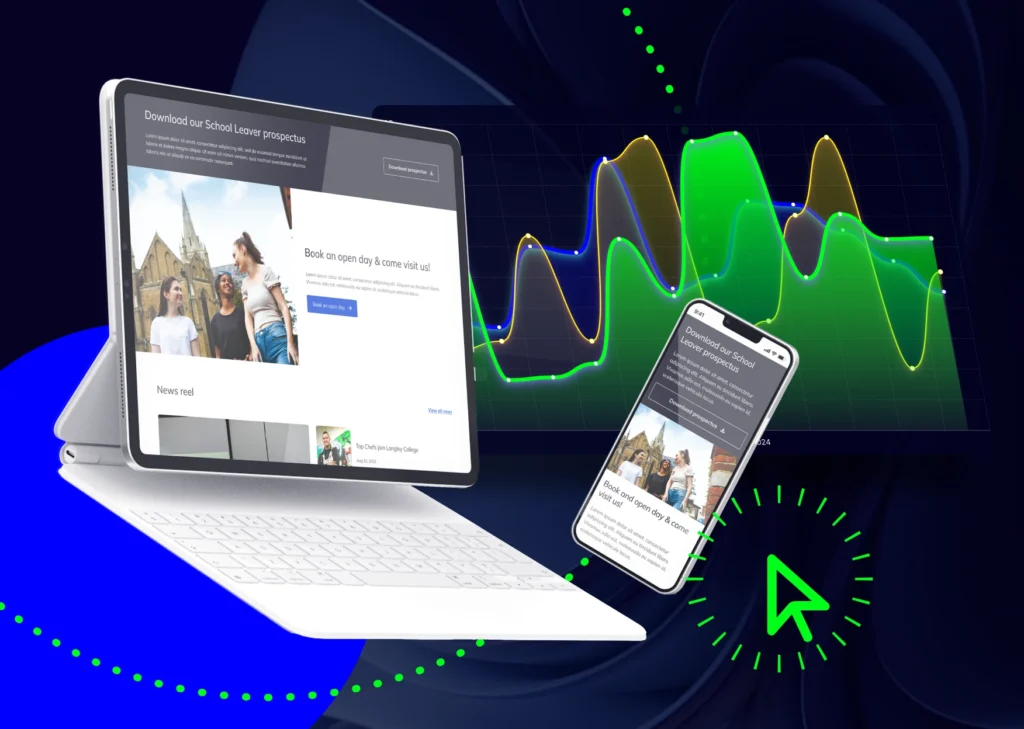
UX influences every commercial component on your website. It shapes how user journeys unfold, how efficiently you acquire customers, how effectively you convert them, and how likely they are to return.
When UX is optimised, conversion rates improve because users can move through journeys without hesitation. Acquisition costs decrease because more of your existing traffic converts. Retention improves because the experience builds trust and clarity. Operational costs can also fall as users find what they need without relying on support teams.
Strong UX delivers a compounding effect, as any improvements in this area amplify the performance of other channels. For example, with a good UX that leads to faster conversions, paid media becomes more efficient and SEO traffic delivers greater value. Content works harder when your UX is strategically optimised.
This is why UX should be seen as a multiplier rather than a standalone discipline. It enhances everything else you invest in, and has a serious knock-on effect on the overall ROI of your website.
Consider UX in Journeys Beyond Pages
Many organisations still approach UX at a page level, where individual templates are optimised without considering how users move between them. This is a fundamental limitation, as users do not experience websites as isolated pages.
Rather, users experience journeys that often begin outside your website and continue across multiple touchpoints. Search results, landing pages, forms, emails, and follow up interactions all contribute to a single experience.
So, a more effective way to understand UX is through a journey framework. Attention to your brand is the starting point, engagement follows when content aligns with intent. Then, confidence develops when users feel informed and reassured. Finally, conversion is the natural outcome when these stages are connected.
In many user journeys, confidence is the missing layer. Many websites provide information but fail to build trust. This is particularly important in sectors where decisions carry weight, such as education, legal services, and finance.
Without confidence, users hesitate. And when users hesitate, conversions drop. A strong UX eliminates this risk.
Understanding Enterprise UX Limitations
It’s rare that enterprise websites have one major issue that holds them back. Instead, they may underperform because of multiple small breakdowns across the journey. And when you consider the complexity and variation in enterprise user journeys, these small breakdowns can create a significant issue.
Some experiences fail to capture attention effectively, where users arrive but do not engage because the value proposition is unclear. Others might lose users through friction, where navigation becomes complex, content becomes overwhelming, or calls to action lack clarity. In some cases, the issue is a mismatch between intent and experience. This happens when traffic arrives with a specific expectation that the page does not meet.
There are also scenarios where users progress through the journey but fail to convert into qualified leads or customers. This often points to a lack of alignment between UX and business processes.
Understanding these patterns is essential, as it allows organisations to identify where value is being lost and where improvements will have the greatest impact. However, across all of these examples, the common factor is in UX.
UX Strategy Should Be Data-Driven
UX decisions should never just be driven by opinion, but grounded in evidence.
Enterprise organisations have access to a wealth of data, but it is often underutilised when it comes to digital strategy and UX. Analytics platforms reveal where users enter the site, how they move through it, and where they drop off. Behavioural tools provide deeper insight into how users interact with content and interfaces. Conversion data highlights which journeys lead to meaningful outcomes.
The challenge is not always collecting data, but translating data insights into action. This requires asking the right questions, like which entry points attract high intent users, which pages build momentum and which create friction, or where confidence increases and where it declines?
When these insights are connected, UX becomes more strategic. It moves from reacting to problems to proactively shaping experiences that drive performance.
Optimising UX is a Continuous Exercise
There’s a common assumption that UX is something you address once, usually during a redesign. Once the new site is launched, the focus shifts elsewhere and UX enhancements are forgotten. Needless to say, this approach limits long term performance.
User behaviour changes over time, expectations evolve, and new channels introduce new types of traffic. Competitors are also always raising the standard, and having a static UX strategy cannot keep pace with these changes.
The best solution is to treat UX as an ongoing process. Continuously test, refine, and optimise UX based on data and real user behaviour. Regularly making small improvements creates compounding gains over time.
This approach ensures that UX continues to deliver value long after the initial launch. Remember, it’s a marathon, not a sprint.

Taking a Structured Approach to Enterprise UX
We’ve established that data, measurement, and user-centred planning creates effective UX. This means good UX never happens by accident. It requires a structured process that connects your business goals with user needs.
Strong UX begins with discovery and alignment. Organisations need a clear understanding of their audience, their objectives, and the challenges within existing experiences. Without this foundation, design decisions will lack strategic direction.
Then, the experience strategy follows. This is where user journeys are mapped, content is aligned with intent, and conversion pathways are defined. It ensures that every part of the experience serves a purpose.
Design and prototyping bring these ideas to life in a tangible way. At this stage, the focus should remain on usability and clarity rather than aesthetics alone. Prototypes allow teams to explore and refine ideas before full development begins.
Validation is the next essential step, where testing with real users reveals whether the experience performs as intended. Validation highlights areas of friction and opportunities for improvement.
The final stage is not an end point. As already established, continuous optimisation ensures that the user experience evolves in response to data and changing user behaviour. The most effective UX processes are cyclical, and not linear.
When organisations take this kind of structured approach to developing UX plans, instead of making UX decisions based on a gut feel, the difference in outcome and performance is clear.
UX and Enterprise WordPress
For organisations operating at scale, the choice of website platform plays a major role in enabling effective UX. WordPress offers a level of flexibility that supports modern experience design, particularly when implemented with a strong strategic foundation.
Modular content structures allow teams to create and adapt experiences efficiently, scalable design systems ensure consistency across large and complex sites. Integrations with CRM and marketing platforms enable more connected journeys.
However, technology alone is not enough. The value of WordPress is realised when it is combined with a clear UX strategy that aligns with business goals and user needs. Explore our detailed guide on UX principles for WordPress for further insight.

Treat UX as a Strategic Investment
UX is often viewed as a cost within digital projects. In reality, it’s one of the most impactful investments an organisation can make. It’s not just an aesthetic choice, but a factor that directly impacts ROI.
UX determines whether your website captures value or loses it. It influences how effectively your marketing performs, and it shapes how users perceive your brand.
The question is not whether UX is worth investing in, but how much value is being left on the table without a strategic UX approach. For enterprise organisations, the answer is usually significant.
If your UX isn’t actively driving revenue, it may be time for a change. Partner with Itineris to ensure your website delivers maximum ROI.