Enterprise Website Checklist
Enterprise websites are complex by nature. They need to support multiple audiences, integrate with wider systems, scale over time, and deliver measurable business impact. All this, while maintaining a high-quality user experience. Getting this right involves understanding how strategy, design, technology, and ongoing optimisation all work together.
This guide brings those moving parts into a structured framework. By breaking enterprise website planning, building, and launch into defined pillars, it helps ensure nothing critical is overlooked.
The result is a more considered approach to execution that reduces risk, improves performance from the start, and sets a stronger foundation for long-term success.


Lee Hanbury-Pickett is a Senior Developer at Itineris, bringing over a decade of expertise to the team. Having been with the company for 10 years, Lee specialises in building and maintaining WordPress websites, combining technical precision with creative problem-solving. With extensive experience and a deep understanding of the industry, he plays a key role in delivering high-quality digital solutions that support clients’ goals and enhance user experiences.
Table of Contents
Getting Enterprise Website Execution Right
Ensuring the long-term success of an enterprise website requires strategic planning, careful execution, and ongoing maintenance. To succeed across these areas, enterprise website management can cover five key pillars:
- Strategy and Setup
- Design and Build
- Tech and SEO
- Launch
- Maintenance and Optimisation
Various subtasks and processes fall within these core pillars to ensure enterprise websites are created and managed at an optimal level.
Below is a breakdown of the fundamental tasks required for any enterprise website build, migration, or update.

1. Strategy and Setup
Every successful enterprise website build starts long before design or development begins. Strategy and setup define what the website needs to achieve, who it needs to work for, and how it supports wider business goals. Without this foundation, even well-built websites struggle to deliver meaningful results after launch.
What Will Your Website Achieve?
Complex enterprise websites rarely exist for a single purpose. They operate as multi-functional platforms that must support a wide range of audiences, each with different expectations, levels of intent, and definitions of value.
To be effective, enterprise websites require clearly defined roles within the business. Not just what the website measures, but what it is fundamentally there to do.
For example, your website may need to:
- Drive high-intent conversions for prospective customers
- Support existing clients through self-service tools or account access
- Act as a central knowledge hub for stakeholders, partners, or media
- Enable recruitment by showcasing culture and opportunities
- Strengthen brand perception across global markets
Each of these is a distinct objective, often serving entirely different audiences. The challenge is not choosing one, but intentionally balancing them when designing and planning your site.
Without clear prioritisation, large-scale websites can become diluted, trying to serve everyone equally and ultimately underperforming across the board. Instead, you need to define:
- Which audiences matter most to your organisation
- What success looks like for each of those audiences
- How your website supports those outcomes at a strategic level
By establishing this upfront, you create a clear purpose for your platform. It ensures every feature, content type, and user experience decision is aligned to a defined role within the wider business, rather than simply contributing to surface-level performance metrics.
Define Measurable Business Outcomes and KPIs
Effective websites need to be tied to clear business outcomes to deliver measurable value. That means moving beyond simply monitoring traffic and focusing on metrics like lead quality, application volume, revenue contribution, or engagement depth. These metrics directly tie your website’s role to revenue.
With average conversion rates typically sitting between 2-5%, even marginal gains can unlock significant commercial impact, particularly at an enterprise scale. This is why defining the right KPIs from the outset is so important, as it ensures your website is built to perform against meaningful targets, and not just generate activity.
Audience Segmentation and User Journey Mapping
Enterprise audiences are complex, with different needs, motivations, and routes to conversion. This means websites rarely provide a single linear journey.
Mapping distinct user journeys across personas, regions, and stages of intent allows you to design experiences that guide users effectively across your website. From discovery through to decision, each audience segment should have a clearly defined pathway and digital experience.
This kind of clarity underpins everything from navigation to content strategy, ensuring your website works for real users, not internal assumptions.
See our in-depth guide to user-centred website design →Platform and CMS Architecture
From a technical point of view, the platform your website is built on is arguably your most important decision.
Enterprise websites require a scalability-first approach to their foundation. The platform you choose will either enable your website’s growth potential or limit it.
Enterprise websites need the right CMS that supports high traffic levels, scalability, governance, and performance, allowing multiple teams to operate efficiently without compromising quality. Of course, the exact CMS you choose must align with the broader architecture of your digital presence and how your site integrates with existing systems, from CRM and marketing automation to analytics and personalisation tools.
This ensures your website operates as part of a connected ecosystem, rather than a standalone asset. This establishes a platform that supports current requirements, and is also flexible enough to adapt as your technology stack and business needs evolve.
At Itineris, we are one of a select few WordPress VIP partners, and specialise in enterprise website development. Get in touch with our team to discuss the best CMS for your needs.
Content Strategy and Governance Model
Without a clear content strategy, enterprise websites can quickly become fragmented, duplicated, and difficult to manage.
The impact is on user experience, but a poor content strategy also weakens SEO performance. A defined governance model, covering ownership, workflows, and standards, ensures your content remains consistent, relevant, and aligned to business goals as it scales. Having this established early sets your website up for long-term success.
Data, Tracking, and Analytics Framework
You cannot optimise what you can’t measure.
Enterprise websites require a robust analytics framework that tracks meaningful interactions across channels and touchpoints. Defining tracking requirements early ensures your website captures the data needed to understand performance, attribute conversions, and support confident decision-making.
Learn how enterprise sites can apply data insights more effectively →Stakeholder Alignment and Workflow Planning
Large-scale websites involve multiple stakeholders, each with their own priorities. Without clear alignment, projects can slow down and outputs can become inconsistent.
Establishing defined roles, responsibilities, and workflows ensures smoother collaboration, faster delivery, and a website that reflects a unified vision, not competing internal agendas.
2. Design and Build
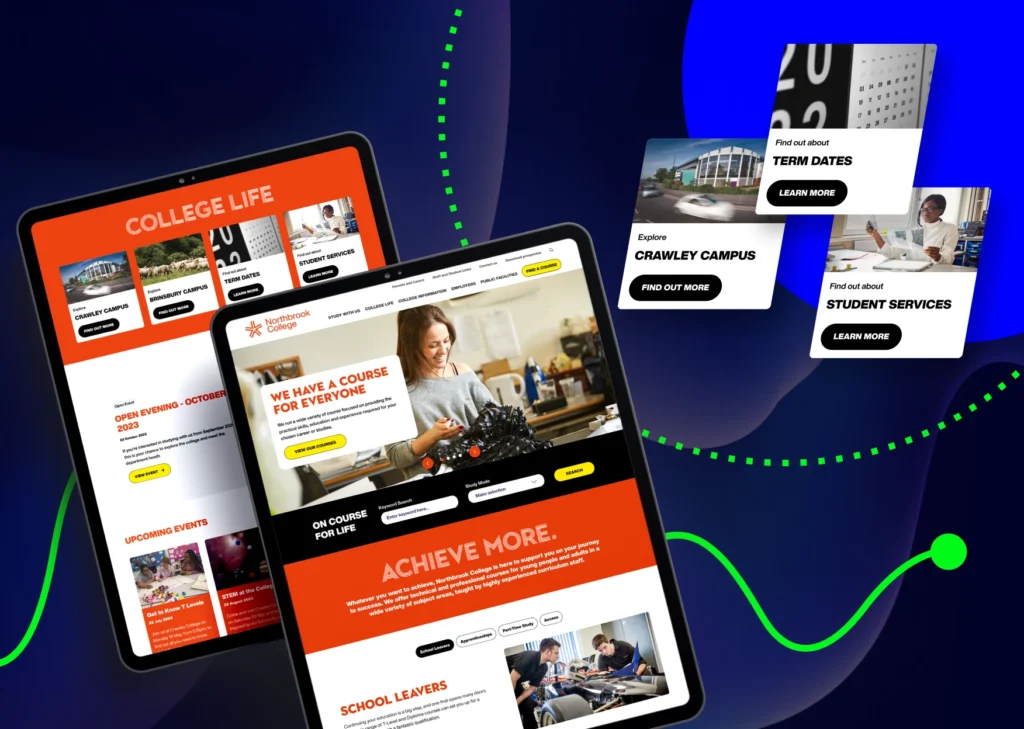
Once the strategic direction is clear, the focus shifts to how the website is actually built and experienced. This stage is where user journeys, design systems, and scalable development all come together to create a platform that works in the real world, not just in theory. Done properly, the build phase sets the tone for performance long after launch.
UX Architecture Based On Real User Behaviour
Any effective user experience starts with understanding how people actually navigate and interact with your website, not how internal teams think they should. In enterprise organisations, it’s common for site structures to mirror internal departments, product lines, or organisational hierarchies. The problem is, your actual users don’t think that way.
Instead, they arrive with specific goals, questions, and levels of intent. If your architecture doesn’t reflect that, friction in the user journey can build up quickly.
Designing around real user behaviour means using data, search insights, and journey analysis to shape navigation, content groupings, and pathways. It’s about reducing cognitive load, shortening the distance between entry point and outcome, and making next steps obvious.
Getting this right makes your website feel intuitive. However, overlook it, and even the highest-quality content or strong propositions won’t perform because users simply cannot find what they need.
Explore the fundamentals of enterprise website design →Responsive, Optimised Design
Mobile is the primary experience for a significant proportion of users. This often means the majority of your traffic is arriving via smaller screens, in shorter sessions, with less patience.
Designing mobile-first is about forcing clarity. It prioritises what really matters, strips away unnecessary complexity, and ensures that key journeys work under tighter constraints. Navigation must be simple, content more focused, and interactions more deliberate.
Responsive design then builds on this foundation, ensuring that experience scales effectively across devices, from mobile to desktop and everything in between.
When executed properly, this results in a platform that performs consistently wherever and however users choose to engage.
Conversion-Focused Design Systems
At an enterprise level, design should actively contribute to performance. That means embedding best-practice, conversion-led thinking into every reusable element.
Strategic calls to action, forms, content blocks, and navigation patterns should all be designed and tested with outcomes in mind, not just aesthetics.
A well-structured design system also creates a feedback loop. As you gather data on what works, components can be refined and rolled out across the entire site, which drives continuous improvement without reinventing the wheel each time.
This approach ensures that as your website scales, it becomes more effective, and not just larger.
Accessibility and Compliance
Website accessibility is not just a bolt-on or a final-stage check once your website is built. Instead, it’s a core part of how enterprise websites should be designed and built from the outset.
Adhering to WCAG standards ensures your website is usable by people with a wide range of abilities, including those using assistive technologies. However, accessible web design also helps people without disabilities. Ultimately, this isn’t just about compliance or risk mitigation, though both are important at an enterprise level. Rather, it’s about removing unnecessary barriers.
Accessible websites offer clearer navigation, better contrast, logical structures, and well-labelled interactions which benefit all users, not just those with specific needs. In practice, accessible websites are often simpler, clearer, and more effective. They reduce friction, improve engagement, and create a more inclusive experience across the board.
Scalable Component-Based Development
Enterprise websites evolve constantly, with new content, campaigns, and requirements being added over time. Without the right foundation in place, that growth can quickly lead to complexity and inefficiency.
Component-based development addresses this by breaking the website into flexible, reusable building blocks. These components can be combined in different ways, giving teams the freedom to create new pages and experiences without starting from scratch.
For content teams, this means greater autonomy and faster publishing. For development teams, it reduces duplication and simplifies maintenance. And for the business, it ensures consistency without slowing down execution.
Ultimately, it’s what allows large, complex websites to scale without becoming unmanageable.
Performance-Led Design Decisions
Design choices have a direct and measurable impact on how your website performs. Web design is not just about how things look, but how quickly your site loads, how smoothly elements respond, and how easily users can interact with each page.
Heavy imagery, unnecessary animations, and overly complex layouts can all degrade performance, particularly on mobile or slower connections. And when performance drops, so does engagement and conversion.
Taking a performance-led design approach means considering speed and efficiency at every stage of the design process. It’s about making deliberate trade-offs, prioritising what adds real value, and ensuring the experience remains fast and responsive.
Getting this right results in a website that looks polished and works reliably under real-world conditions, which is what ultimately drives better outcomes.
3. Tech and SEO
The technical and SEO foundation of a website plays a huge role in whether it succeeds or underperforms. From site structure and speed to indexing and integrations, these elements determine how easily users and search engines can access and engage with your content. Strong technical planning during the build stage prevents long-term performance issues later on.
Core Web Vitals and Page Speed Optimisation
Website speed is one of the most important technical metrics for enterprise sites. This is not only because it helps your website perform on search engines, but it also shapes how your website feels to use.
Users expect pages to load instantly, interactions to respond without delay, and content to remain stable as it renders. If that doesn’t happen, bounce rates and a lack of trust in your brand can follow.
At an enterprise level, even marginal improvements in load time can translate into meaningful gains in engagement and conversion. This is especially true across high-volume pages or key commercial journeys.
Optimising Core Web Vitals means focusing on how performance is experienced in the real world: how quickly key content appears, how responsive the page is to input, and how stable the layout remains. It requires a combination of design, development, and infrastructure decisions working together.
When done properly, strong performance offers any website a competitive advantage. It’s not just a hygiene factor.
Technical SEO Foundations
Search performance starts long before any content is created. The first essential step is ensuring search engines can efficiently access, interpret, and prioritise your pages.
Enterprise websites often introduce complexity through scale, with large volumes of pages, multiple templates, international variations, and layered navigation. Without careful control over all of these areas, this complexity can lead to issues such as duplicate content, crawl inefficiencies, or important pages being overlooked.
Strong technical SEO foundations ensure your site is structured in a way that search engines can easily understand. This includes managing how content is discovered, how authority flows through the site, and how different sections are prioritised. This is something that should be clearly established from the very beginning of your website being planned and launched.
Ultimately, it’s about creating a framework that supports visibility at scale, rather than constantly fixing issues after they arise.
Information Architecture and URL Structure
As websites grow, their structure becomes increasingly important. What works for a smaller site quickly breaks down when you’re managing hundreds or thousands of pages across multiple audiences or regions.
A clear information architecture organises content in a way that reflects user needs while remaining logically structured for search engines. It defines how sections relate to one another, how deep content sits within the site, and how easily users can move between topics.
URL structure plays a key role in reinforcing this. Clean, consistent URLs make content easier to understand, easier to manage, and easier to scale. They also provide important context to search engines about page relevance and hierarchy.
Getting this right early on prevents the need for disruptive restructuring later and creates a solid foundation for long-term growth.
On-Page SEO and Content Optimisation
Consistency is one of the biggest challenges for enterprise websites. With large volumes of content being created and updated by multiple teams, maintaining quality and alignment can quickly become difficult.
On-page SEO provides the framework to manage this at scale. It ensures that elements like metadata, headings, internal linking, and content structure are applied in a consistent and purposeful way across the site.
More importantly, it aligns content with search intent. Each page should have a clear role, targeting specific queries and supporting defined user needs.
Rather than treating optimisation as a one-off task, it becomes an ongoing process, supported by templates, guidelines, and governance that keep standards high as your site evolves.
Schema Markup and Structured Data
Search and answer engines are increasingly focused on understanding context, not just keywords. This is a particularly important factor with AI search snippets and AEO becoming such a prominent factor in discoverability.
Structured data helps provide that context, making it clearer what your content represents and how it should be interpreted.
For enterprise websites, properly structured data can unlock additional visibility through enhanced search results, such as rich snippets, FAQs, position zero AI search snippets, or detailed listings. These features improve both rankings and how your content appears in search, making it more prominent and more compelling to click.
Implementing schema at scale requires planning. It needs to be embedded into templates and applied consistently across relevant content types, rather than added manually page by page. Ideally, this is something planned at the start of a website build or update, and not bolted on after the fact.
Security, Hosting, and Infrastructure Resilience
Enterprise websites need to perform reliably under a wide range of conditions. Traffic spikes, campaign launches, and seasonal demand can all place significant strain on your infrastructure.
Enterprise hosting and security setups need to be built to handle that to avoid performance and risk issues.
A resilient infrastructure ensures your website remains fast, stable, and secure at all times. This includes scalable hosting environments, robust security protocols, and proactive monitoring to identify and resolve issues before they impact users.
Beyond simply avoiding downtime, a resilient website protects your brand, safeguards user data, and maintains trust across every interaction.
Integration with Marketing and CRM Systems
A website on its own has limited value. Its real power comes from how it connects with the rest of your digital ecosystem.
Integrating with CRM and marketing platforms allows data to move without issue between systems. User interactions on your website can inform lead scoring, trigger automated campaigns, and feed into broader reporting and analysis.
This level of integration is essential for enterprise organisations. It enables a more joined-up approach to marketing, where activity is coordinated, measurable, and continuously optimised.
Instead of acting as a standalone channel, your website becomes a central hub that supports everything from acquisition to retention and gives you a clearer view of performance across the entire customer lifecycle.

4. Launch
Launching an enterprise website is a carefully managed process. From testing and migration planning to tracking validation and performance checks, the launch phase ensures everything works exactly as it should when the site goes live. Getting this right protects existing traffic, supports a smooth transition, and avoids costly post-launch fixes.
Pre-Launch QA and Testing Across Devices
Any smooth website launch is built on thorough testing.
Enterprise websites need to be validated across a wide range of devices, browsers, and user journeys to ensure everything works as intended. This goes beyond surface-level checks, covering functionality, content accuracy, integrations, and edge cases.
Strong QA minimises risk at go-live and prevents avoidable issues from impacting users or performance.
SEO Migration and Redirect Strategy
Migration is one of the highest-risk moments for any established website. Without a clear plan, valuable rankings and traffic can disappear overnight.
A structured redirect strategy ensures that existing URLs are mapped correctly, preserving authority and guiding both users and search engines to the right content. Done properly, it protects visibility and creates a stable foundation for future growth.
Performance and Load Testing at Scale
Testing a website in controlled environments may be essential, but it only tells part of the story. Enterprise websites must be able to handle real-world demand, which includes traffic spikes driven by campaigns or seasonal peaks.
Load testing simulates these conditions, helping identify bottlenecks and weaknesses early. This ensures your site remains fast and stable when it matters most.
Analytics and Tracking Validation
Reliable data starts before launch. Every tracking point, goal, and integration needs to be tested to ensure it’s capturing accurate, meaningful information. This includes user journeys, conversion events, and cross-platform data flow.
Getting this right from the beginning of your website launch avoids reporting gaps and gives you immediate confidence in your performance data.
Stakeholder Training and CMS Onboarding
Needless to say, teams need to know how to use your enterprise platform. Training ensures stakeholders understand how to manage content, follow governance processes, and use the CMS effectively.
This is necessary for improving day-to-day efficiency and in maintaining consistency and quality as the site evolves.
Soft Launch and Phased Rollout Strategy
For enterprise organisations, a full-scale launch isn’t always the safest approach. A phased rollout allows you to release the site in stages, monitor behaviour, and resolve issues in a controlled way.
It provides space to gather feedback, validate performance, and refine the experience before wider exposure. Doing so reduces risk and improves the overall quality of your launch.

5. Maintenance and Optimisation
A website should never stop evolving once it’s live. Ongoing optimisation, performance monitoring, and content improvements are what turn a well-built site into a high-performing long-term platform. Enterprise websites that continue to grow and improve after launch are the ones that consistently deliver real business value.
Continuous Performance Monitoring and Optimisation
Much of this enterprise website checklist has been focused on establishing a solid ground for website performance. However, even if all of the right boxes have been ticked, performance doesn’t stand still once a site goes live.
As content expands, features are added, and traffic patterns shift, performance can gradually decline if your site is not carefully maintained. For large-scale enterprise websites, this need is crucial.
Ongoing monitoring helps identify issues early, from slower load times to unstable elements, so they can be addressed before they affect users. Regular optimisation keeps the experience fast, reliable, secure, accessible, and aligned with user expectations over time.
Ongoing SEO Strategy and Content Expansion
Search visibility is built over time, not delivered in one go at launch. Enterprise websites need a structured approach to continually improve existing content, identify gaps, and expand into new areas of opportunity.
This includes refining underperforming pages, strengthening topical authority, and responding to changes in search behaviour.
Conversion Rate Optimisation (CRO)
There is always room to improve how users move through your website. CRO focuses on understanding behaviour, identifying friction points, and testing changes that encourage more users to take action.
At scale, even small improvements in conversion rates can have a significant commercial impact. It’s an ongoing process of refinement, rather than a one-off exercise.
Data-Led Decision Making and Reporting
Enterprise websites generate large volumes of data, but value comes from how that data is used.
Clear reporting frameworks help connect user behaviour to business outcomes, making it easier to understand what’s working and where improvements are needed. This allows decisions to be based on evidence rather than assumption, which supports more focused and effective optimisation.
Security Updates and Technical Maintenance
Ongoing maintenance is essential to keep your website secure and stable. Regular updates to the platform, plugins, and infrastructure help protect against vulnerabilities and ensure compatibility as technologies evolve.
This reduces risk, maintains performance, and supports compliance, particularly for organisations handling` sensitive data or operating at scale.
Governance, Scalability, and Content Lifecycle Management
As enterprise websites grow, so does the risk of inconsistency, duplication, and outdated content. Strong governance provides the structure needed to maintain quality, defining how content is created, reviewed, and managed over time.
Effective lifecycle management ensures that content remains relevant, with clear processes for updating, archiving, or removing pages as needed.
Experimentation and Innovation Roadmap
Enterprise websites should evolve continuously, not just reactively. An experimentation roadmap creates space to test new ideas, whether that’s refining user journeys, introducing new functionality, or adopting emerging technologies.
This structured approach to innovation helps you stay ahead of changing user expectations while ensuring improvements are purposeful and measurable.
Key Takeaways
Executing an enterprise website successfully requires great design and advanced technology, but most importantly, it demands a holistic approach. Clear strategy, thoughtful design, robust technical foundations, careful launch planning, and ongoing optimisation all work together to deliver measurable business outcomes.
Each pillar in this guide highlights essential considerations to ensure your website not only launches smoothly but continues to evolve and perform at scale.
For enterprise websites that truly deliver, partner with Itineris to plan, build, and optimise your digital platform from strategy to execution.