
Synopsis
- Your website is where clients decide: most people research a firm online before they get in touch, so the site has to build trust in seconds.
- Law firms have particular needs: clear practice-area navigation, SRA transparency requirements, accessibility, and a tone that’s professional but approachable.
- Design for clients, then search: dedicated service and location pages, real people, proof of expertise and a fast, mobile-friendly site.
- Built on the right platform: a CMS your team can update without a developer, and secure, reliable hosting.
Before people ask for a referral, most search online, and almost all of them look at a firm’s website before making contact. Your website is where they decide whether you understand their problem and whether they trust you to solve it. This guide covers what makes law firm website design work: the challenges specific to legal websites, the elements every successful site needs, and examples from firms we’ve worked with.
If you’re planning a new site, see how we build WordPress websites for law firms.
The challenges of law firm website design
Building trust in seconds
Law is built on credibility, and visitors make up their minds quickly. A site that looks dated, hides key information or doesn’t show expertise sends people straight back to the search results. Put the trust signals where people see them first: accreditations, rankings in the legal directories, client testimonials and case outcomes, and real photography of your people rather than stock images. Trust is also the foundation of law firm lead generation; read more about building digital trust.
Clear navigation across practice areas
Visitors usually arrive with a specific problem, whether that’s a divorce, an employment dispute or a commercial contract. If they can’t find the right practice area quickly, they’ll leave. Organise the site around how clients describe their needs, in plain language, with practice areas, people and insights connected to each other, and contact details always within reach. Most legal searches happen on phones, so the navigation has to work just as well on a small screen.
When we rebuilt the website for Bristows, a firm with many specialist practice areas, clearer navigation and a better user experience reduced the bounce rate by 22%.
SRA rules, data protection and accessibility
Law firm websites carry regulatory obligations that most sites don’t. Firms regulated by the Solicitors Regulation Authority must follow its Transparency Rules: publish price and service information for certain services, such as residential conveyancing, probate, employment tribunal claims for unfair or wrongful dismissal, and immigration; explain their complaints procedure; and display the SRA’s clickable digital badge. Barristers have equivalent rules from the Bar Standards Board.
Marketing must not be misleading, and enquiry forms, cookies and client data must be handled in line with UK GDPR. The site should also meet WCAG 2.2 AA accessibility standards, so everyone can use it, including the many clients who come to a firm at a difficult time. Accessible sites are also easier for everyone to use and for search engines to understand.
Professional but approachable
People looking for legal help are often anxious, and pages full of jargon push them away. Write in plain English, explain what happens next, introduce your people with proper profiles and, where it suits your firm, short videos. Helpful guides that answer common questions build trust and bring in search traffic at the same time.
Standing out in a crowded market
The legal market is competitive, and many firms win by going deep rather than wide. If you specialise, prove it: in-depth insights, case studies and commentary that speak directly to your clients’ challenges show why they should choose you over the firm in the next search result.

What a successful law firm website needs
A client-centred experience
Design for the client first and search engines second. Each page should make clear who it’s for, how you can help and what to do next, with a clear call to action, such as booking a consultation or calling the team. Make it easy to get in touch in more than one way, and consider secure online enquiry or onboarding forms that capture the right details up front. Our guide to user-centred design explains the approach.
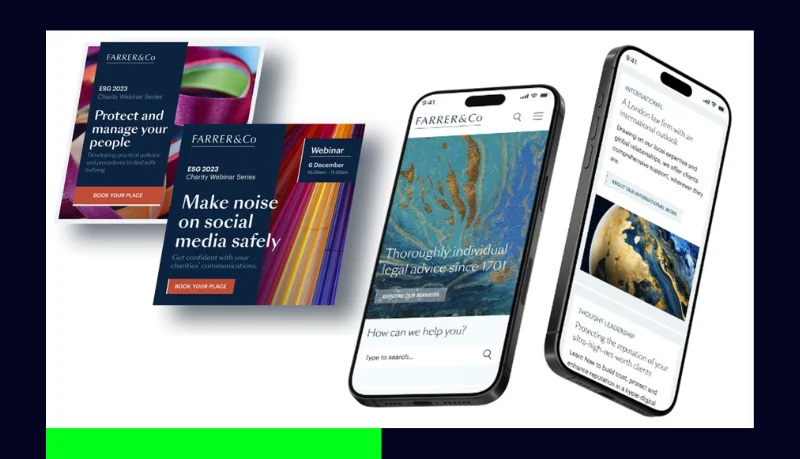
For Farrer & Co, a long-established firm whose clients traditionally came through referrals, a client-centred digital experience helped modernise how the firm wins work online and reduced the bounce rate by 32%.
A strong brand and real people
Clients choose people as much as firms. Professional photography of your team, detailed profiles, a clear statement of your values and real evidence (testimonials, reviews, directory rankings and memberships of bodies such as the Law Society) make your expertise tangible and your firm memorable.
Speed, security and SEO
A great website only works if people can find it and it loads quickly. Optimise images and scripts, use reliable hosting and keep the site secure and up to date: see our WordPress performance guide. Make sure each page has a clear purpose, a descriptive title and a logical heading structure, so search engines and AI search tools can understand it. Most firms also need a local search strategy: read our guide to local SEO for law firms, or see our SEO services for law firms.

Service and landing pages for every practice area
A single “Legal services” page can’t rank for, or persuade, everyone. Give each practice area its own page, such as family law, employment law, commercial property or dispute resolution, that explains the problems you solve, who you help, how the process works, what it costs where you can say, and who the client will work with.
If you have offices in several places, add location pages, such as “Divorce solicitors in Bristol”, with genuinely local content: the team, the office and relevant local work. And build dedicated landing pages for campaigns, so paid search and social campaigns send people to a page that matches what they clicked on.
Choosing a CMS and hosting for a law firm website
Your team should be able to publish insights, update people profiles and add pages without waiting for a developer. WordPress gives firms that independence, along with the flexibility to integrate with CRMs, practice management and marketing tools; read why WordPress is a strong choice for larger organisations.
Hosting matters just as much: a law firm website must be secure, fast and reliable, including when a high-profile case or campaign brings a surge of visitors. We host most firms’ sites on Kinsta, where we’re an Elite Partner, and use WordPress VIP for the largest international firms.
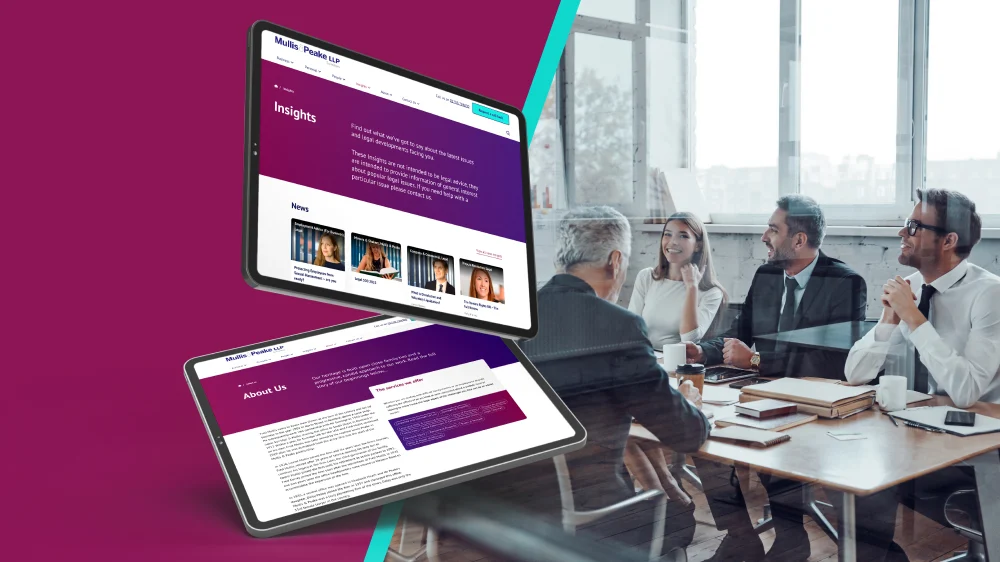
Law firm website design examples
Here are some of the law firms we’ve worked with. Each project was different, but all of them involved clear, accessible user journeys that helped the firm reach and engage more clients.
Bristows
A website for a firm with many specialist practice areas, where clearer navigation and user journeys reduced the bounce rate by 22%.

Farrer & Co
A client-centred digital experience for a traditional, referral-led firm, which reduced the bounce rate by 32%.
Mullis & Peake

HFW

Law firm website design FAQs
What should a law firm website include?
A page for each practice area, profiles of your people, clear contact options on every page, evidence such as testimonials and directory rankings, helpful insights, and the information regulators require, such as SRA price and service information and your complaints procedure. It should be fast, mobile-friendly and accessible.
What do the SRA rules require on a law firm website?
Under the SRA Transparency Rules, firms must publish price and service information for certain services, including residential conveyancing, probate and some employment and immigration work, explain their complaints procedure, and display the SRA’s digital badge. Check the SRA’s guidance for the full requirements for your firm.
What is the best CMS for a law firm website?
For most firms, WordPress: it’s flexible, secure when properly managed, easy for marketing teams to update and integrates with CRMs and other tools. The largest firms may benefit from WordPress VIP’s managed enterprise platform.
Work with a law firm website design agency
A law firm website should build trust, make it easy to find the right expertise and turn visitors into enquiries, while meeting your regulatory obligations. That takes an agency that understands how law firms win work.
We design and build websites for law firms, from regional practices to international firms. See how we build WordPress websites for law firms and our wider digital marketing for law firms, or talk to our team about your website.