WordPress in 2026: How the CMS is Empowering Enterprises
WordPress may be the world’s most widely used CMS, but it’s also a serious enterprise platform.
Its scale brings the strategic advantage of proven infrastructure, deep integration capability, and a global talent pool that reduces long-term risk. But scale is only one part of the story.
WordPress has evolved into a flexible, hybrid system that supports structured content, modern front-end frameworks, AI-assisted workflows, and enterprise-grade security. For organisations of all scale, it offers control, agility, and sustainable growth.
To understand the possibilities of the CMS, this guide explores some of the key shifts and trends that we’re seeing in WordPress in 2026.

Mark Perry is a Digital Project Manager at Itineris, dedicated to fostering strong client relationships and driving success through innovative digital solutions. With a focus on clear communication and collaboration, he ensures every project aligns with client goals, delivering exceptional results and creating long-term value for all stakeholders.
Table of Contents
- WordPress’s Strategic Market Dominance
- The Hybrid CMS Model Offers Enterprise Agility
- WordPress is an Intelligent CMS
- Structured Content and Patterns Replace Monolithic Templates
- AI Embedded in Workflows
- Strengthened Performance and Security
- WordPress Supports Responsive and Accessible Design
- Owning Your Data and Avoiding Lock-In
- WordPress in 2026 is an Enterprise Platform
WordPress’s Strategic Market Dominance
In exploring how WordPress is evolving, it’s important to note that the platform’s sheer scale is still one of its strongest assets.
Around 43% of all websites use WordPress, making it by far the most widely-used platform. Among the sites built with a CMS, WordPress holds a roughly 61% market share, which is more than all other CMSs combined. Even among the top 10,000 and top 100,000 highest-traffic sites, WordPress still holds a significant footprint, with nearly one in four.
A CMS with this kind of scale comes with many positive effects. There are tens of thousands of plugins and themes available, a massive global developer community, and volumes of tooling that no rival ecosystem can match.
For enterprises, that means:
- Talent availability: developers, designers and integrators familiar with WordPress are abundant. This makes it a lot easier to build and maintain a strong digital presence on the platform
- Ecosystem stability: WordPress has plenty of well-established patterns, tested components, and community vetting, which reduces risk
- Interoperability: plugins and APIs connect to broader martech stacks without bespoke engineering
If you operate on a smaller CMS, the lack of scale could become a long-term risk. However, with WordPress, scale provides strategic leverage.
The Hybrid CMS Model Offers Enterprise Agility
Traditional CMS architectures are generally divided into two schools. The first is monolithic, where frontend templates and backend content live tightly coupled. The other is headless, where content lives in a backend and is delivered to decoupled frontends via APIs.
However, enterprise teams today are more frequently choosing hybrid-CMS approaches that combine the best of both worlds. This can be an enticing reason to consider WordPress, as the CMS’s hybrid nature enables:
- Visual editing and content management, with tools like the Site Editor and block-based patterns
- REST/GraphQL APIs that feed content into headless frontends (React, Next.js, other app frameworks)
By using WordPress as a hybrid CMS, organisations can empower editorial teams with visual interfaces, and maintain performance and custom UX through modern frontend frameworks. A hybrid CMS setup also avoids the fragmentation and ongoing maintenance complexity of pure headless stacks.
This flexibility aligns with enterprise needs for scale, control and performance, without unnecessary architectural friction.
WordPress is an Intelligent CMS
A significant WordPress shift is that the CMS is no longer just a place where content is created and stored. It is increasingly becoming a system where digital work is orchestrated.
The maturation of the Site Editor, Synced Patterns, Block Bindings and collaboration capabilities signals a transition from page-building to structured system-building.
Instead of stitching together multiple tools, enterprises can now use WordPress to:
- Manage structured data visually
- Centralise governance without restricting teams
- Connect design systems directly to live business data
- Keep editorial workflows inside one unified interface
This marks the end of what many teams experienced over the last five years: the “complexity tax” of over-engineered stacks. Headless-only builds, multiple visual tools, duplicated logic, and fragile integrations often recreated the very rigidity they were meant to escape.
Modern WordPress represents the return of integrated advantage, without the historical downsides of monolithic platforms.
Structured Content and Patterns Replace Monolithic Templates
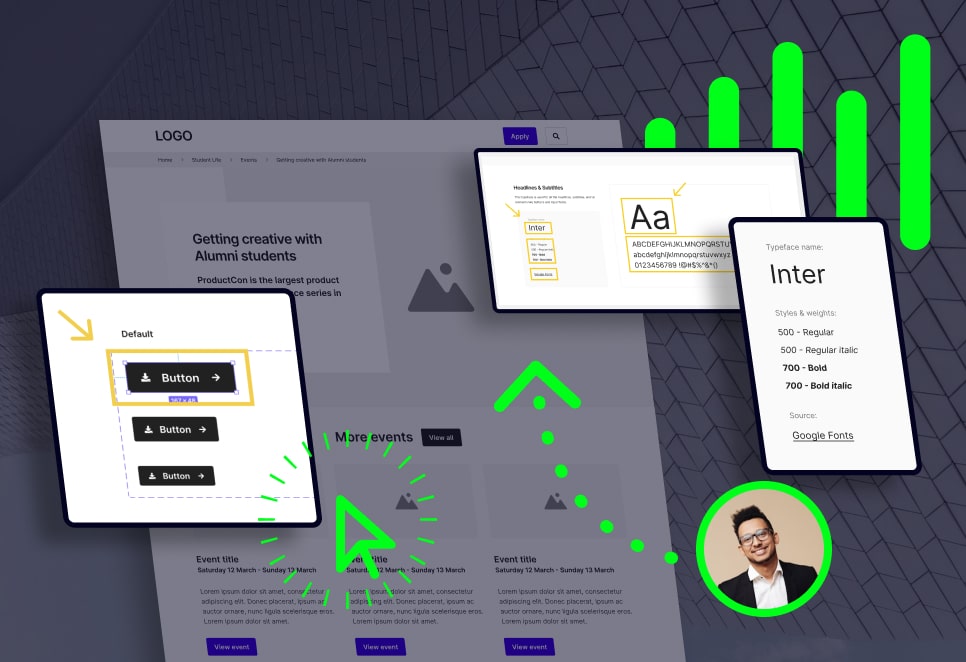
One of the biggest shifts in WordPress right now is in how teams structure content.
Gone are the brittle, one-off templates. In their place are block-based patterns (reusable design building blocks). These used structured data schemas that map complex content types to interfaces. They are synced components across contexts (eg. landing pages, product templates, author bios).
This approach brings three significant benefits to enterprise workflows:
- Governed design systems: A structured, centrally managed design framework that enforces a consistent visual language, brand identity, and user experience across all sites and digital touchpoints.
- Faster iteration: Flexible, reusable design patterns and components that enable teams to launch new pages and campaigns quickly, without relying on lengthy engineering cycles.
- Lower technical debt: A reduced reliance on bespoke templates and one-off builds, making the platform easier to maintain, scale, and evolve over the long term.
For organisations with multiple brands or multilingual operations, these structural patterns make publishing a significantly more efficient and productive process.
AI Embedded in Workflows
AI is rapidly becoming an operational staple for many digital operations.
According to business trend analyses, AI adoption is moving beyond experimentation into day-to-day use cases like content assistance, SEO automation, image optimisation and chatbots. For organisations built on a WordPress foundation, this presents opportunities.
In modern WordPress setups, we see features including:
- AI-enhanced content drafts and SEO recommendations that speed editorial processes
- Automation in tagging, meta-data generation and content optimisation
- AI chat interfaces that reduce support burden
These AI functions are about amplifying human productivity, which is consistent with industry data that shows how AI adoption leads to measurable efficiency gains.
And when we look at AI adoption, a key area of focus is the move from generative AI to agentic AI. Quite simply, generative AI creates while agentic AI acts.
Through emerging foundations like the Abilities API and broader AI integration standards, WordPress is moving toward a model where:
- Plugins can declare what they can do in machine-readable ways
- AI agents can discover and execute those capabilities
- Workflows can be triggered and completed programmatically
- Governance and permissions remain intact
This transforms WordPress from a publishing interface into a programmable operating system for digital operations. In this environment, tasks like having an AI agent publishing a campaign, triggering compliance review, or updating metadata are all possible without manual interface interaction.
Again, the scale of the WordPress plugin ecosystem makes this especially powerful. A 60,000+ plugin ecosystem, once agent-enabled, becomes an exponential advantage that proprietary vendors cannot easily replicate.
Strengthened Performance and Security
For any digital presence, a high level of performance and security are baseline expectations. This is particularly true for an enterprise web platform.
Modern WordPress development prioritises various factors to enhance security and performance. This includes Core Web Vitals compliance and performance optimisation, as well as various security best practices (like dependency management and automated patching workflows). WordPress also supports modern caching and delivery strategies.
This is not to mention WordPress VIP, the most advanced version of the platform designed for enterprise websites. With WordPress VIP, security and performance features are at the highest level, ensuring the most optimal web presence for sites of any scale or demand.
Why does this matter?
A slow or insecure website damages user trust, degrades SEO performance, and increases operational risk. In fact, a recent threat analysis found that plugins account for over 90% of identified WordPress vulnerabilities, underscoring the need for governance over third-party code.
At Itineris, we build performance and security into every phase, from planning to launch to ongoing optimisation, so enterprise teams aren’t left retrofitting these requirements later. Get in touch to find out more.
WordPress Supports Responsive and Accessible Design
Global usage data continues to reinforce that mobile traffic dominates digital experiences. Users expect sites that work flawlessly across devices, which requires responsive design from the foundation.
Modern WordPress tooling supports this, helping teams build responsive layouts out of the box. In WordPress, block patterns are optimised for smaller screens, and performance-first assets prioritise mobile loading speed.
With Google’s ongoing emphasis on mobile-first indexing, ensuring WordPress sites are designed with mobile as a primary context is essential for search-performance, as well as UX.
To add to this is the importance of digital accessibility. Accessibility may be a compliance checkbox, but it’s also a strategic imperative for your users. Quite simply, an accessible website provides a more engaging digital experience for all users, while also performing better in search engines.
WCAG guidelines and legal requirements in many regions require websites to be accessible to users with disabilities. WordPress teams now routinely build with keyboard-navigable interfaces, semantic HTML and ARIA attributes, and accessible block components and themes. The CMS is one of the best platforms for establishing a highly accessible digital presence.
Owning Your Data and Avoiding Lock-In
One of WordPress’s most long-standing strategic advantages, especially in enterprise contexts, is data ownership. Unlike proprietary, closed platforms, with WordPress you:
- Own your content, metadata and schema
- Control hosting, security policies and infrastructure choices
- Retain flexibility to evolve without vendor lock-in
That freedom matters when organisations need to build custom integrations, migrate to new hosting or platforms, or reuse content across channels.
Long-term agility is built on ownership and choice, and this is a key area where WordPress delivers an advantage for sites of all size and complexity.
Through the REST API, evolving data portability initiatives, and bi-directional integrations, WordPress can function as:
- A central content warehouse
- A universal content layer across channels
- A system that feeds satellite sites, apps and internal tools
- A platform that accepts updates back into core systems
This approach aligns with modern JAMstack and MACH architectures, but without forcing organisations into rigid composable suites or expensive integration layers.
As an enterprise, an important question to ask is whether your data is portable or trapped?
Proprietary platforms often hold content in opaque schemas, increasing exit costs and reducing flexibility. WordPress, by contrast, keeps content architectures open and exportable by design.
WordPress in 2026 is an Enterprise Platform
WordPress in 2026 represents maturity. It’s a platform that combines scale, flexibility, structured content, AI-enabled workflows, and enterprise-grade performance, giving organisations room to grow without adding unnecessary complexity. The question is no longer whether WordPress can support enterprise ambition, but how strategically it’s implemented.
At Itineris, we help organisations turn WordPress into a long-term digital advantage. As a trusted WordPress VIP agency partner, we design, build, and optimise platforms that balance innovation with governance, performance, and agility. If you’re ready to build a stronger digital presence on WordPress, just get in touch.